
Roof Vent & Chimney Leak Repair in Petaling Jaya
Xoo Roofing provides expert repair services for leaks originating from roof vents, chimneys, and other roof penetrations across Petaling Jaya and the Klang Valley. Our service covers flashing replacement, industrial-grade sealant application, vent boot replacement, and chimney cap inspection — addressing the most common leak sources around roof penetrations.
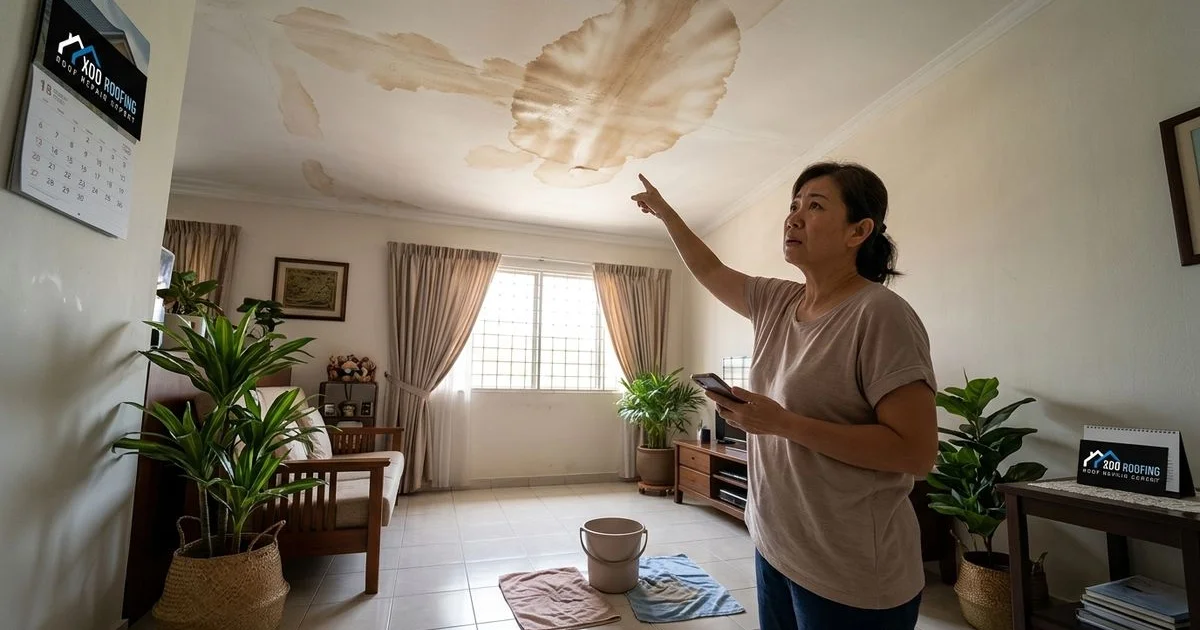
Why Homeowners Call Us for Vent & Chimney
If any of these sound familiar, you are not alone. These are the most common reasons Klang Valley homeowners contact Xoo Roofing.
Active Water Leaks
Water drips or stains appearing on your ceiling after heavy rain, causing damage to your home interior.
Worried About Hidden Costs
Previous contractors quoted low but added hidden charges. You want a team with transparent, upfront pricing.
Previous Repairs That Failed
Another contractor tried to fix it but the problem came back. You need a team that fixes the root cause.
Monsoon Season Approaching
The next heavy rain could cause significant damage. You need a reliable fix before the storms arrive.
Expert Roof Vent and Chimney Leak Repair in Petaling Jaya
Every pipe, vent, chimney, skylight, and antenna mount that penetrates through your roof surface creates a potential leak point. These penetrations interrupt the continuous waterproof barrier of your roof, and the materials used to seal them — flashing, sealant, and rubber boots — are among the first components to fail in Malaysia’s punishing tropical climate.
Xoo Roofing specialises in diagnosing and repairing leaks at roof penetrations across Petaling Jaya, Shah Alam, Subang Jaya, Puchong, Damansara, and the wider Klang Valley. Our technicians use industrial-grade materials and systematic investigation methods to deliver permanent repairs at these critical junction points.
Why Roof Penetrations Are the Most Common Leak Source
Roofing professionals worldwide agree that penetrations are the number one source of roof leaks. The reason is straightforward: every hole cut through a roof interrupts the natural water-shedding system and creates a junction that must be sealed with secondary materials. Over time, these sealing materials degrade, and water finds a way in.
UV Degradation of Sealants and Rubber
Malaysia sits almost directly on the equator, receiving some of the highest UV radiation levels in the world. UV light is the primary enemy of the sealants and rubber components used around roof penetrations. Silicone sealants become brittle and crack. Rubber vent boots split and shrink. Mastic compounds dry out and lose adhesion. This degradation happens gradually and is often invisible from ground level until a leak develops.
Thermal Cycling Stress
Roof surfaces in the Klang Valley experience temperature swings from ambient morning temperatures to over 60°C in the afternoon sun, then cooling rapidly during evening thunderstorms. Our article on why roofs leak during heavy rain explains how these conditions exploit weak points. This constant expansion and contraction cycle stresses the joints between different materials — metal flashing against concrete walls, rubber boots around steel pipes, sealant between tiles and chimneys. Each cycle opens gaps microscopically wider until water can enter.
Improper Original Installation
Many roof penetration leaks we encounter in the Klang Valley trace back to poor initial installation. Common installation errors include insufficient flashing overlap, use of consumer-grade sealant instead of industrial products, incorrect flashing step direction that channels water toward the penetration rather than away from it, and missing counter-flashing at wall junctions.
Types of Penetration Leaks We Repair
Our technicians handle every type of roof penetration leak found in Malaysian residential and commercial properties.
Chimney and Fireplace Leaks
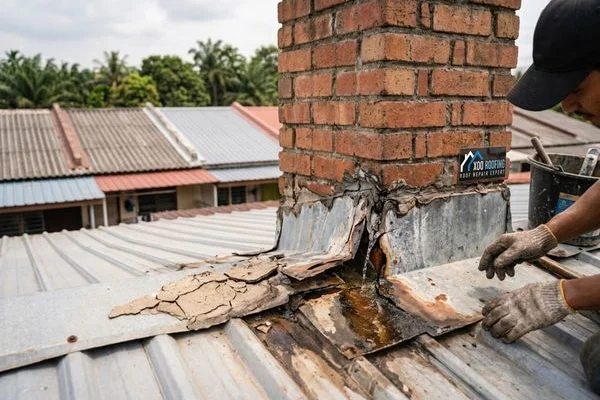
While fireplaces are less common in Malaysia than in temperate countries, many properties — particularly bungalows and older homes — have chimney-style structures for kitchen exhaust or decorative purposes. The junction between a chimney and the surrounding roof tiles is sealed with step flashing and counter-flashing that must be precisely installed to prevent water entry.
Common chimney leak causes include:
- Deteriorated step flashing — the metal strips that interleave with tiles along the chimney sides
- Failed counter-flashing — the upper piece of flashing embedded in the chimney mortar joint
- Cracked chimney crown — the concrete cap at the top of the chimney
- Missing or damaged chimney cap — allows direct rain entry into the chimney interior
- Deteriorated mortar joints — gaps in the brickwork or block wall that allow water penetration
Plumbing Vent Pipe Leaks
Every home has plumbing vent pipes that extend through the roof to allow air into the drainage system. These pipes are typically sealed with a rubber or neoprene boot that slides over the pipe and is flashed to the surrounding tiles. The rubber boot is the weak point — UV exposure causes it to crack, shrink, and eventually split, creating a gap around the pipe.
Our repair approach involves removing the degraded vent boot, cleaning the pipe surface, installing a new UV-resistant vent boot with proper compression fit, and sealing the base to the surrounding tiles or flashing.
Kitchen and Bathroom Exhaust Vent Leaks
Kitchen exhaust hoods and bathroom extraction fans are vented through the roof in many Malaysian homes. The vent cowl or cap on the roof is sealed with flashing and sealant. Over time, both materials degrade, and the vent opening becomes a water entry point during driving rain.
Skylight Leaks
Skylights are increasingly popular in Malaysian homes for natural daylighting. However, the large opening required for a skylight creates an extensive junction that must be carefully sealed. Skylight leaks are typically caused by failed perimeter flashing, deteriorated frame sealant, or condensation issues from temperature differentials between indoor and outdoor air.
Antenna and Satellite Dish Mounting Points
Television antennas, satellite dishes, and telecommunications equipment are frequently mounted directly on roofs, with support brackets penetrating the roof surface. These mounting points are often sealed hastily during installation with consumer-grade silicone that fails within a year or two. We replace these seals with industrial-grade materials and proper flashing boots.
Solar Panel Mounting Points
With the growing adoption of solar panels in Malaysia, roof penetrations for panel mounting rails are an increasing source of leaks. Improper sealing of mounting bolt holes is the most common issue. We inspect, reseal, and flash all solar panel mounting points as part of our repair service.
Our Repair Materials and Methods
The difference between a repair that lasts one year and one that lasts ten years comes down to the materials used and how they are applied. Xoo Roofing uses only professional-grade materials specifically rated for tropical conditions.
Industrial-Grade Flashing
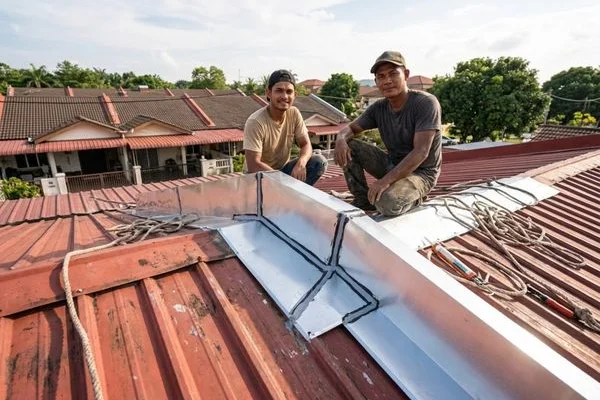
We use heavy-gauge aluminium flashing that resists corrosion in Malaysia’s humid, saline-influenced air. For high-stress areas, we use lead or lead-substitute flashing that can be dressed to conform to complex shapes. All flashing is mechanically fixed and sealed with compatible sealant — never just glued in place.
Professional Sealants
Consumer-grade silicone from the hardware store may last a year on a sun-exposed roof. We use industrial polyurethane and modified silicone sealants that are UV-stabilised, elastomeric (they stretch and compress with temperature changes), and rated for prolonged water contact. These sealants maintain their integrity for five to ten years in tropical conditions.
UV-Resistant Vent Boots
Standard rubber vent boots can crack within three to five years in Malaysian sun exposure. We install premium EPDM (ethylene propylene diene monomer) vent boots that are specifically designed for UV resistance and maintain their flexibility and seal integrity for significantly longer.
Diagnosing Penetration Leaks
Penetration leaks can be particularly challenging to diagnose because water often enters at one point and travels along a beam, pipe, or membrane before dripping into the living space at a different location. Our systematic investigation process ensures we identify the actual source.
Step 1: Interior Mapping
We examine the visible leak point on the ceiling and map the water staining pattern. The shape and direction of staining provides clues about which direction the water is travelling.
Step 2: Roof Space Investigation
From inside the attic, we follow the water trail upstream from the ceiling drip point. We check along beams, pipes, and any horizontal surfaces where water could be travelling laterally.
Step 3: Exterior Penetration Inspection
On the roof surface, we systematically inspect every penetration within the area indicated by our interior investigation. We check flashing, sealant, vent boots, mortar joints, and surrounding tiles for any signs of failure.
Step 4: Controlled Water Testing
If the source is not visually apparent, we use a garden hose to apply water to individual penetrations one at a time while a second technician observes from inside the attic. This isolation test pinpoints the exact entry point with certainty.
Why “Just Add More Sealant” Never Works
The most common approach by inexperienced contractors or DIY homeowners is to squeeze more silicone sealant over the existing failed seal. This approach fails for several critical reasons:
- Silicone does not bond to dirty or wet surfaces — and the area around a leak is usually both
- UV exposure breaks down consumer silicone within one to two years in Malaysia’s climate
- Sealant bridges gaps but does not create a structural seal — water finds its way underneath
- Layering sealant over sealant creates a thicker but weaker seal — the layers do not bond to each other properly
The correct approach is to remove all old sealant and flashing, clean the surfaces thoroughly, install new flashing with proper mechanical fixing, and apply industrial-grade sealant at the edges. This creates a durable, structural seal that withstands Malaysia’s climate for years.
Preventive Maintenance for Roof Penetrations
Once we have repaired your leak, we recommend periodic preventive maintenance to keep all roof penetrations watertight:
- Annual visual inspection — check sealant condition and look for cracks in vent boots
- Sealant renewal every 5 years — reapply industrial sealant before existing sealant fails
- Vent boot replacement every 8 to 10 years — proactive replacement prevents leaks
- Flashing inspection after storms — high winds can lift or displace flashing
- Chimney cap check — verify the cap is intact and mortar is sound
Service Coverage
Xoo Roofing provides roof vent and chimney leak repair across Petaling Jaya, Shah Alam, Subang Jaya, Puchong, Damansara, Bangsar, Kelana Jaya, USJ, Ara Damansara, Kota Damansara, Tropicana, Bandar Utama, and all surrounding areas in the Klang Valley.
Contact us today for expert penetration leak diagnosis and repair. We fix the source, not the symptom.
How Does Vent & Chimney Work?
Leak Source Investigation
We inspect all roof penetrations — vents, chimneys, pipes, skylights — to identify the exact source of the leak using visual and water testing methods.
Damage Assessment
We assess the condition of flashing, sealant, vent boots, and surrounding tiles to determine the scope of repair needed.
Repair Plan & Quotation
A detailed repair plan is prepared with transparent pricing. We explain what needs replacing and why, so you understand every item in the quotation.
Professional Repair
Using industrial-grade materials, we replace failed flashing, vent boots, and sealant, ensuring every penetration is fully waterproofed.
Water Testing & Verification
We conduct a controlled water test on the repaired area to verify the fix is completely watertight before completing the job.
Why Choose Xoo Roofing for Vent & Chimney?
Penetration Leak Specialists
Roof penetrations are the most common source of leaks. Our technicians specialise in diagnosing and repairing leaks at these critical junctions.
Industrial-Grade Materials
We use professional-grade flashing, sealants, and vent boots rated for Malaysia's UV intensity and rainfall — not consumer-grade products from the hardware store.
Thorough Investigation
We inspect every roof penetration, not just the one you suspect. Leaks from vents and chimneys often migrate, making the visible drip point misleading.
Water Test Guarantee
Every repair is verified with a controlled water test before we consider the job complete.
Get a Free Vent & Chimney Quote Today
Not sure what you need? Our team provides a free, no-obligation assessment and transparent quotation. No hidden costs, no pressure.
Before & After
What Our Customers Say
"We had a persistent leak near our kitchen exhaust vent that two contractors failed to fix. Xoo Roofing identified that the vent boot had cracked and the flashing had separated. They replaced both and the leak is completely gone."
Dr. Tan Boon Huat
Damansara
"The chimney area on our bungalow had been leaking for months. Xoo Roofing stripped the old flashing, applied new aluminium flashing with industrial sealant, and did a water test to prove it was fixed. Excellent work."
Faizal bin Mohd Ali
Petaling Jaya
Frequently Asked Questions
Why do roof vents and chimneys leak so often?
Every penetration through the roof surface creates a potential weak point. The junction between the roof surface and the penetration is sealed with flashing and sealant, both of which degrade over time from UV exposure, thermal cycling, and weathering — especially in Malaysia's harsh tropical climate.
What is flashing and why does it fail?
Flashing is a thin strip of metal (usually aluminium or galvanised steel) that seals the joint between a roof penetration and the surrounding tiles or cladding. It fails due to corrosion, thermal expansion, improper initial installation, or simply age-related deterioration.
What is a vent boot?
A vent boot is a rubber or neoprene collar that seals around pipes penetrating through the roof, such as plumbing vents and exhaust pipes. The rubber degrades from UV exposure over time, cracking and allowing water to enter around the pipe.
Can you repair leaks around skylights?
Yes. Skylight leaks are typically caused by failed flashing or deteriorated sealant around the skylight frame. We replace the flashing and reseal the skylight perimeter to restore a watertight seal.
How long does a vent or chimney leak repair take?
Most vent and chimney leak repairs can be completed in a single day. Complex repairs involving multiple penetrations or extensive flashing replacement may require two days.
Related Services
Roof Leak Repair
Fast, reliable roof leak repair in Petaling Jaya and Klang Valley. Same-day emergency dispatch with a 25-point inspection and workmanship warranty.
Roof Waterproofing
Multi-layer roof waterproofing systems in Petaling Jaya and Klang Valley. Custom solutions for flat, pitched, and metal roofs with UV-resistant coatings.
Water Leaking Through Ceiling
Emergency ceiling leak repair in Petaling Jaya and Klang Valley. Same-day response, source tracing, permanent repair, and mould assessment included.
Need Vent & Chimney?
Get a free inspection and transparent quotation today. Same-day response, zero hidden costs.