What to Do When Your Flat Roof Leaks During Monsoon
Practical steps to handle a flat roof leak during monsoon season in Malaysia. Emergency measures, permanent fixes, and prevention tips for homeowners.

Hong Seng
Founder & Licensed Roofing Contractor
From what we see in the field every November to March, knowing what to do when your flat roof leaks during monsoon is the toughest stress test for any Klang Valley homeowner.
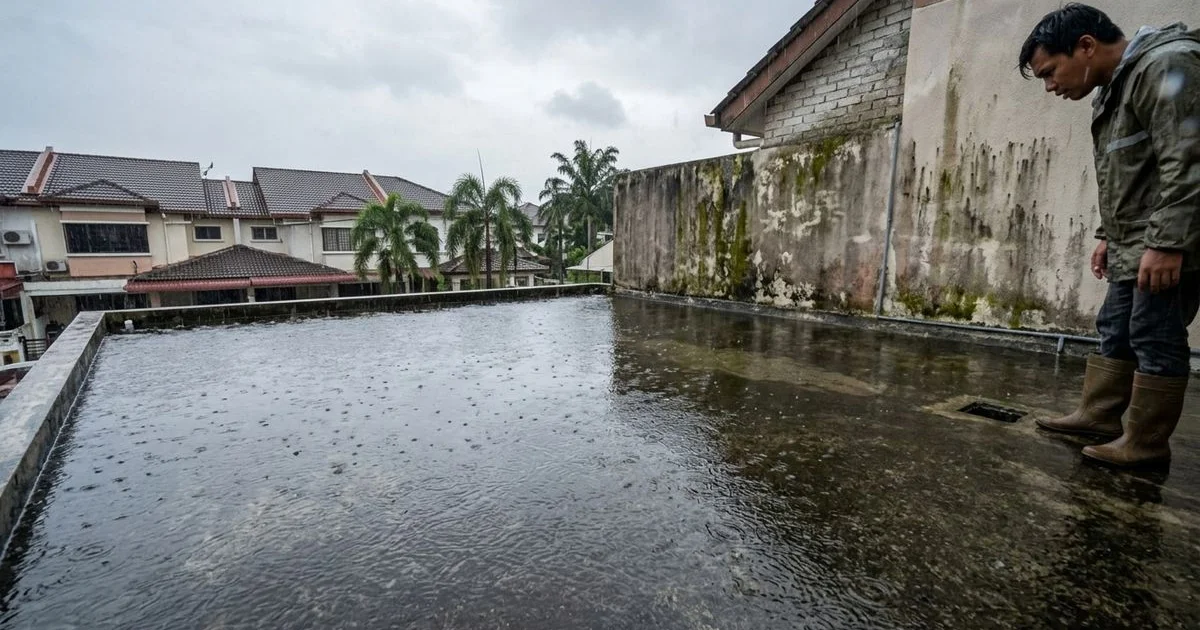
That 3 AM drip usually means standing water has finally compromised a degraded surface layer.
We started Xoo Roofing as a team of five specialists back in 2015, and since then, we have responded to hundreds of these exact monsoon emergencies across Selangor and Kuala Lumpur.
Handling the situation correctly in the moment prevents minor water ingress from becoming a massive structural issue.
Let’s look at the data on why these structures fail under heavy precipitation, walk through the exact emergency measures to take, and outline the permanent fixes that actually work.
Immediate Steps: What to Do When Your Flat Roof Leaks During Monsoon
Step 1: Protect Your Belongings
Before doing anything else, move furniture, electronics, and valuables away from the affected area. Lay old towels or thick plastic drop cloths over your flooring to prevent warping or staining.
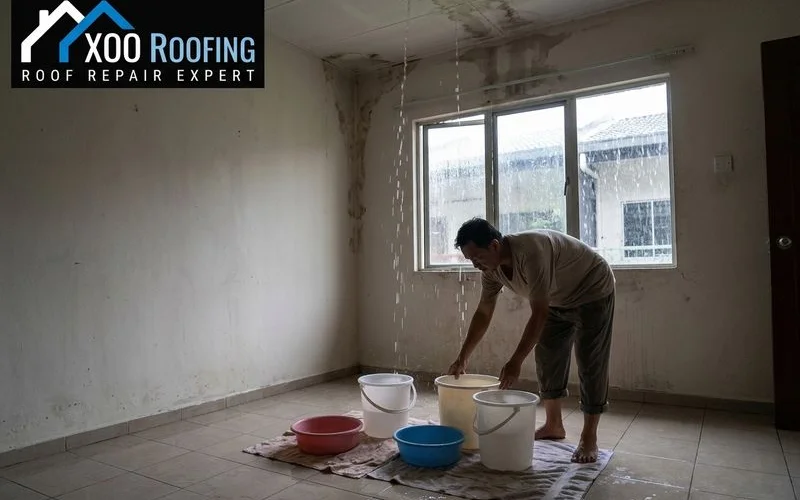
Place large buckets or heavy-duty basins directly under the active drips. A 20-litre paint bucket works exceptionally well for containing high-volume leaks without constant emptying.
If water is pooling on the ceiling and causing the plaster to bulge downward, taking controlled action is essential. Puncturing a small hole at the lowest point of the bulge releases the water safely into a container below. A collapsed ceiling saturated with water causes massive interior destruction and poses a severe injury risk.
Step 2: Turn Off Electrical Supply to Affected Areas
Water mixing with your home’s wiring creates an immediate, life-threatening hazard. We always advise homeowners to switch off the specific circuit breaker (MCB) for the wet room immediately.
Do not touch any light switches or electrical sockets that show signs of moisture.
Tripping the main Residual Current Device (RCD) on your distribution board is the safest move if the leak spreads across multiple rooms. Electrical shocks from saturated plasterboard wiring are entirely preventable with fast action.
Step 3: Document the Damage
Taking clear photos and videos of the active leak, the damaged ceiling, and any ruined furniture is crucial.
PIAM (Persatuan Insurans Am Malaysia) guidelines generally require policyholders to notify their insurance providers of property damage within 14 to 30 days of the incident.
This visual evidence makes processing your homeowner’s insurance claim much smoother.
Our technicians also rely on these videos to trace the exact origin point of the water once the roof dries out. Make sure to note the time of day and the severity of the rainfall when recording.
Step 4: Attempt Temporary Measures (If Safe)
Accessing a slippery surface during an active storm is dangerous, so only attempt these fixes during a dry break in the weather.
Here are a few temporary methods to slow the water entry:
- Clear the drainage outlets: Blocked floor traps are the number one culprit found during inspections. Removing leaves and sediment from the outlet often stops the pooling immediately.
- Apply temporary sealant: Applying a fast-curing product like X’traseal Awning & Roofing Sealant (widely available at local MR.DIY stores) over visible cracks offers excellent short-term relief.
- Secure a heavy tarpaulin: Covering the suspected area with a weighted canvas tarp prevents further rain from hitting the damaged concrete. Use heavy bricks or sandbags, as high monsoon winds easily blow away unsecured covers.
Understanding Why Flat Roofs Leak
To stop the water permanently, you need to understand the physical forces acting on your property during a storm.
Water Pooling
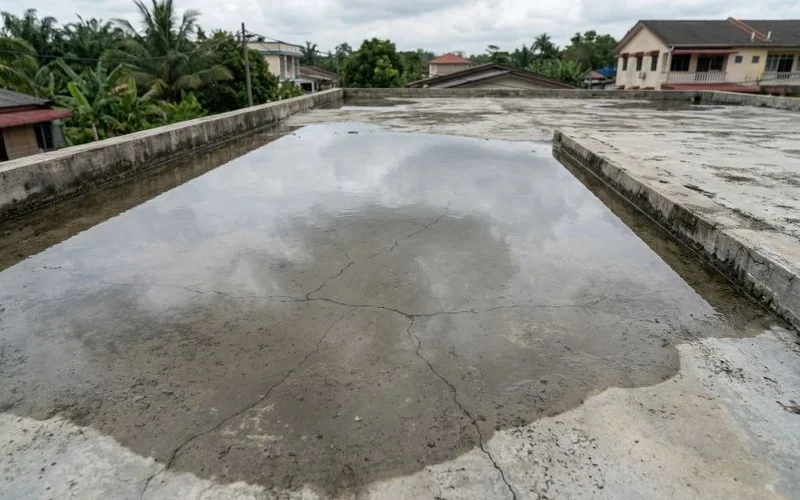
The Uniform Building By-Laws (UBBL) 1984 in Malaysia states that a flat roof must have a minimum gradient of 1:60 to ensure proper runoff. Unfortunately, structural settling or poor initial casting often creates low spots that trap rainwater.
Standing water generates constant hydrostatic pressure against the concrete. This pressure eventually forces moisture through any microscopic weakness in the surface.
Waterproofing Membrane Deterioration
All protective coatings break down eventually under the intense Malaysian sun. The high UV index in the Klang Valley degrades standard polyurethane and acrylic coatings significantly within three to five years.
Once the coating loses its elasticity, it becomes brittle and cracks. You can read our detailed comparison of waterproofing methods to understand which system offers the best UV resistance for your specific layout.
Cracking in the Concrete Slab
Our tropical climate subjects concrete to severe daily thermal cycling. Day temperatures often hit 34°C, causing the slab to expand, while nighttime temperatures drop to 24°C, forcing it to contract.
This continuous movement inevitably creates hairline fractures in the concrete. These tiny fissures become direct highways for rainwater to travel from the roof straight into your living room.
Failed Joints and Penetrations
The junction where the horizontal slab meets a vertical parapet wall is a prime location for failure.
Standard polyurethane sealants applied around PVC vent pipes and drainage holes dry out and shrink within two to four years under direct sunlight. When these joint seals detach, water channels directly into the gaps.
Blocked Drainage Overload
Recent data from MetMalaysia shows that heavy squall lines in the Klang Valley frequently dump over 50mm of rain per hour. Standard 2-inch PVC drain pipes simply cannot handle this massive volume of water fast enough.
When a heavy downpour hits, the system fails in a few specific ways:
- Leaves and twigs block the narrow drain covers entirely.
- The sheer volume of water overtops the existing pipe capacity.
- Water levels rise rapidly across the roof, flooding the weak skirting joints.
This sudden pooling easily penetrates areas that normally stay dry.
Permanent Solutions After Monsoon
Once the dry weather returns, implementing a permanent fix is your top priority to prevent a repeat disaster.
Professional Waterproofing
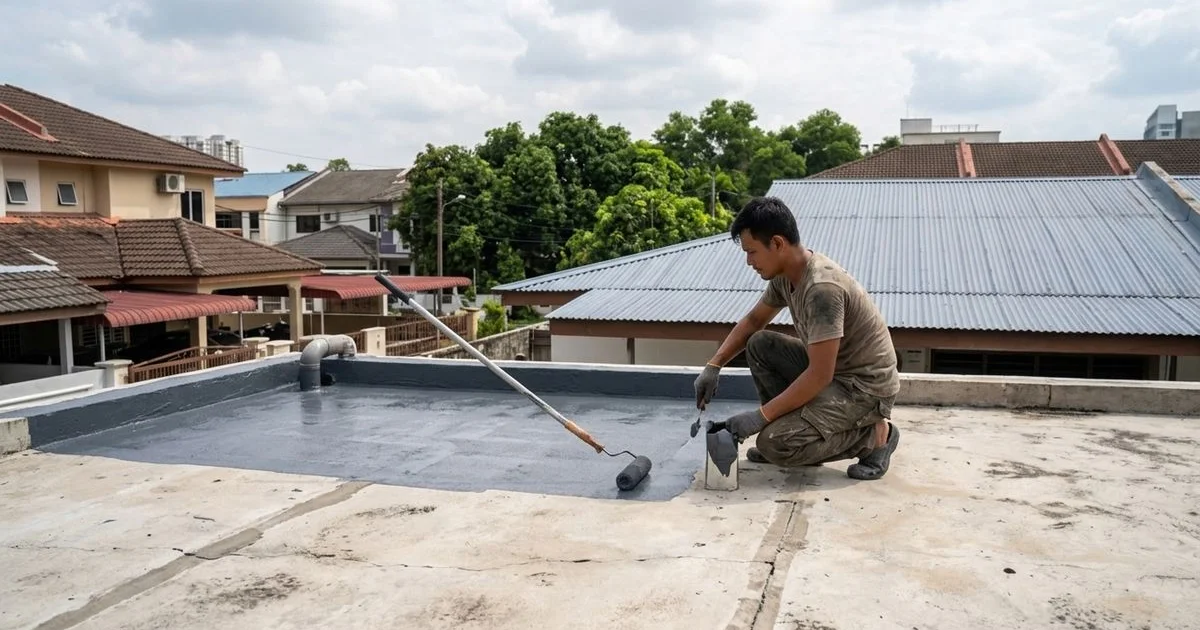
Applying a comprehensive waterproofing treatment is the only guaranteed way to secure the structure long-term.
We assess the exact condition of the slab before recommending a specific material. The right choice depends heavily on the existing surface layout and your budget.
Here is a quick comparison of the two most effective systems:
| System Type | Best Application | Lifespan Expectancy |
|---|---|---|
| Torch-On Bitumen Membrane | Large, unobstructed concrete areas | 10 to 15 years |
| Liquid Polyurethane (PU) Coating | Surfaces with many pipes or complex details | 5 to 10 years |
Both methods create a seamless, watertight barrier when installed by trained professionals.
Drainage Improvement
Upgrading your water removal system dramatically reduces the risk of future pooling.
Replacing standard 2-inch outlets with larger 4-inch rainwater downpipes (RWDP) doubles the drainage capacity during severe storms. Pouring a new concrete screed layer to correct the gradient also ensures water flows directly to these new, larger drains.
Parapet and Joint Treatment
Waterproofing the delicate 90-degree corners requires specific techniques.
Contractors construct a 45-degree angle fillet, known as a cant strip, using non-shrink grout along the base of the parapet wall. This smooth slope prevents water from sitting in the corner and allows the protective membrane to transition seamlessly up the vertical wall.
Prevention: Preparing for the Next Monsoon
Taking proactive steps before the rainy season saves you from expensive emergency repairs. The Northeast Monsoon typically brings the heaviest rainfall to the region from November to March.
- Schedule a pre-monsoon inspection: Getting an expert assessment in September or October identifies degraded seals before they fail.
- Clear drains regularly: Sweeping leaves and debris away from the floor traps every month is a free, highly effective maintenance habit.
- Recoat when due: Inspecting your elastomeric coating annually allows you to spot chalking or thinning early.
- Trim overhanging trees: Cutting back branches stops heavy leaf drops from clogging your gutters and outlets.
Checking the surface 24 hours after a storm is a great diagnostic trick. If you still see puddles, you have a drainage issue that requires immediate attention.
When to Call for Emergency Help
Certain situations demand immediate professional intervention, even if the rain is still falling.
You must contact an emergency responder if you observe any of these warning signs:
- Water flowing directly through light fixtures or down electrical conduits.
- The ceiling plaster sagging significantly, threatening an imminent collapse.
- Brown, rusty water dripping down, which indicates severe corrosion of the internal steel rebar.
- Multiple rooms experiencing heavy leaks simultaneously.
We keep emergency teams on standby because water damage multiplies rapidly by the hour. Ignoring these severe warning signs often leads to replacing the entire ceiling structure rather than just repairing a small patch.
Do Not Let Monsoon Season Catch You Off Guard
Experiencing a roof failure during a heavy squall is incredibly stressful, but fast action mitigates the worst of the damage.
If you are wondering what to do when your flat roof leaks during monsoon, securing your property before the next wet season is the smartest financial decision you can make.
We offer detailed, long-lasting flat roof waterproofing services for residential properties throughout Petaling Jaya and the wider Klang Valley.
Reach out to schedule a full inspection today, and secure your home long before the heavy rains return.
Hong Seng
Founder & Licensed Roofing Contractor
Founder of Xoo Roofing with 10+ years of roofing expertise in Klang Valley.